Sentence Structure & Syntax (WHAT)
The WHAT of sentence structure & syntax

Over the following few newsletters, we will be diving into the role and importance of sentence structure and syntax across the grades. You might be surprised by this topic, and we were too! When we first began researching writing instruction and developing the Layers of Writing Development framework, sentence construction did not even make the cut.
To be honest, we saw grammar instruction as an outdated relic of our own junior high days, filled with exercises like “circle the verb” or “identify the adjective”. Those activities felt disconnected from authentic writing and the meaningful work students do as writers.
However, as we looked deeper into the research on writing development, one finding appeared again and again: strong writers understand sentences. Not just how to punctuate them, but how they work in both structure and syntax. Below, we define sentence structure and sentence syntax to build clarity and to lay the foundation for the strategies we will share in upcoming editions.
Sentence structure
Sentence structure is the understanding of how to organize words in a sentence to form a complete thought. It also involves recognizing which ideas belong together and how to coordinate or expand those ideas to express precise thoughts.
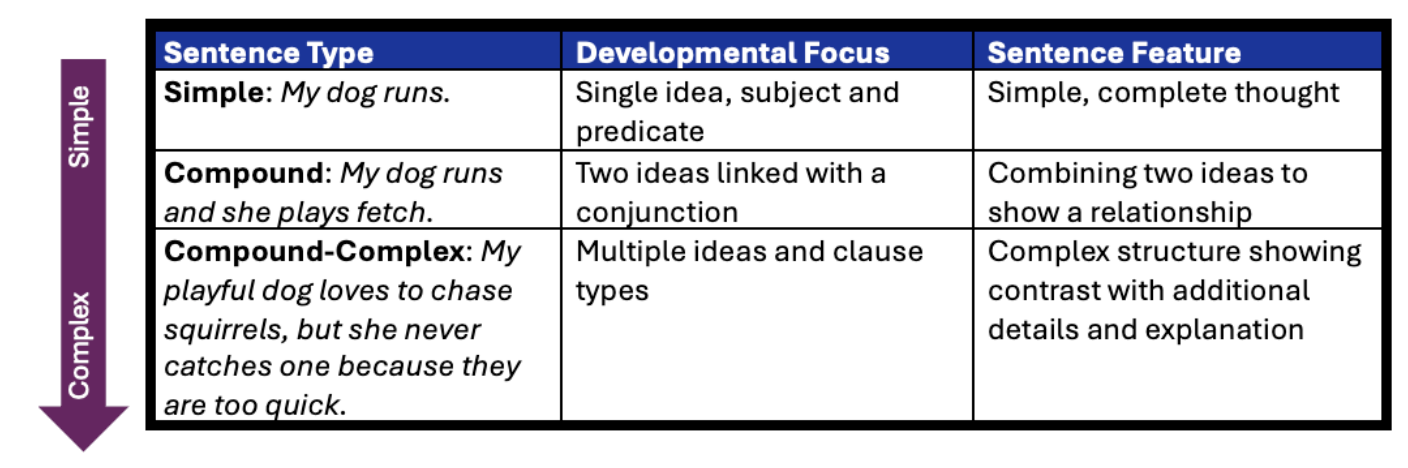
Students learn that sentences can be classified by complexity, simple, compound, complex, or compound-complex, based on how many ideas they contain and the relationships between those ideas. Below is an example of how sentence structure progresses in complexity.
Sentence syntax
Sentence syntax refers to the specific arrangement of words or phrases to convey meaning or emphasize relationships. Knowing how and why we organize words matters. It is not just about adding more ideas, but about how word order signals focus, nuance, and relationship.
For example, consider these four simple words:

Same words, very different emphasis and meaning.
Consider how the meaning changes as you play with syntax in your classroom. Encourage students to notice how shifting a word or phrase changes tone, focus, or intent.
As students learn to combine, expand, and organize their ideas, their understanding of sentence structure and syntax deepens with each new skill. That is why it is essential to begin early, even when students express single, simple thoughts or share ideas verbally. Teaching sentence structure and syntax from the start gives students the tools to build meaning, clarity, and rhythm as their writing and thinking become more complex.