The WHY of Text Structure

As we shared in last week’s newsletter, we define Text Structure as how an author selects and organizes ideas to communicate a message. We also noted that teaching Text Structure is a powerful way to strengthen writing for students of all ages and abilities. A growing body of research shows that explicit instruction in Text Structure also significantly benefits multilingual learners and striving writers (e.g., Hebert et al., 2018; Teng, 2019).
But why does it help?
Teaching Text Structure, and the thinking patterns that underpin each, offers several important benefits. Here are three:
It builds schema in the brain.
Text Structures act like mental ‘filing systems’. When students know the structure, they know the ideas and thinking patterns needed to express themselves clearly or understand a message (e.g., Zhang, 2025).
It improves the clarity and quality of writing.
When students understand how ideas fit together, their writing becomes more coherent, precise, and purposeful (e.g., Algaragere et al., 2023; Hebert et al., 2021).
It deepens comprehension.
Recognizing Text Structures helps students make sense of and organize complex information, supporting stronger reading comprehension across subjects (e.g., Hebert et al., 2016; Oakhill et al., 2015; Roehling et al., 2017).
Click here for a list of some key research and resources we draw from.
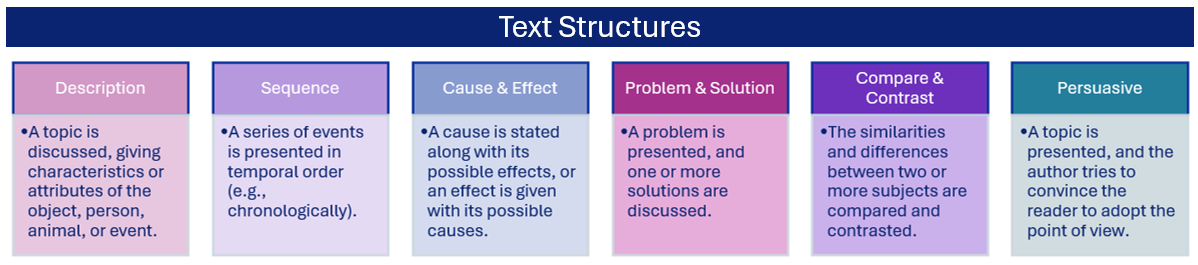
The six text structures
Below are the six Text Structures students use to communicate ideas across grades and disciplines. In the early years, these structures are built orally through talk, play, and shared experiences. As students’ writing skills develop, these structures shift naturally into written production.
Coming up next
In our final two newsletters, we will share some practical strategies to support students’ in developing the thinking patterns for each Text Structure. In the interim, if you’d like to see how Text Structure fits within the broader Layers of Writing framework, visit our website to download a copy.