Fluency (HOW 7-12)
The HOW of fluency

Secondary: HOW we teach fluency
As a secondary teacher, fluency might not always be at the forefront of your lesson design. Yet, fluency remains a critical tool for helping students engage with and comprehend complex texts across all disciplines. When students read fluently, they can focus more on meaning-making, whether they are reading a novel, a primary source document, a word problem, or a lab procedure.
Today, we are sharing a simple and engaging way to build fluency in the secondary classroom: Iceberg Reading.
Strategy: ICEBERG READING
Iceberg Reading is simply a catchy name for repeated readings: having students read the same text more than once, each time with a clear, different purpose. This approach helps students move beyond surface-level understanding and dig deeper into a text, like seeing more of an iceberg below the surface.
Research shows that when readers revisit a text multiple times, they not only improve fluency but also strengthen comprehension and learning. We make this explicit with students and explain that each read helps them notice more, make stronger connections, and gather better evidence.
Select a passage from any discipline.
Tip:Use this strategically with key paragraphs or short text sections that anchor important concepts or themes.
Read the passage three times with purpose. In collaborative groups, students read the same passage three times, with a different goal each time.
Reading 1: Surface level. “What is happening here?” Focus on surface-level details and ideas
Reading 2: Deeper understanding. “Why does this matter?” Notice vocabulary, structures, text features, key ideas and details, and/or author’s choices
Reading 3: Evidence and connections. “What can I do with this?” Collect evidence, synthesize, make inferences, or connect to other learning
Share and discuss. Groups share their insights with the class. If groups used different passages, use a jigsaw approach so students teach each other what they discovered after reading the text three times.
Tip: Having students try this strategy in groups supports all learners and gives striving and multilingual learners the opportunity to expand their vocabularies at a faster rate.
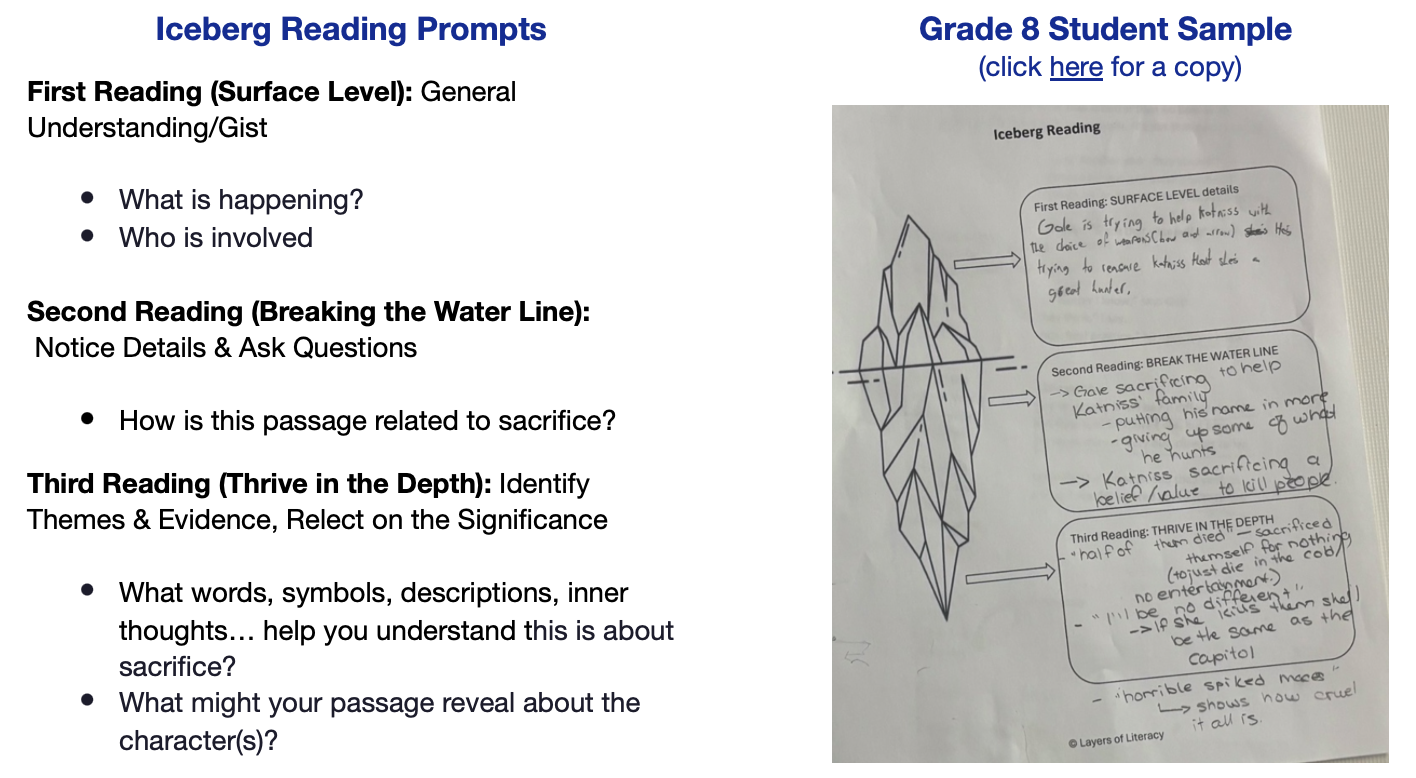
Check out the grade 8 collaborative student sample below. On the left are the prompts we gave students after each reading, and on the right is one group’s Iceberg Reading notetaking page (click here for a copy) where they were looking for evidence of the theme of sacrifice in The Hunger Games (Collins, 2008).
In closing
Across this series, we have explored what fluency is, why it matters, and how to teach it from the early grades through the secondary years. In elementary classrooms, developing accuracy, rate, and prosody lays the foundation for fluent reading. In secondary classrooms, continuing to model and practice fluency helps students access complex texts and engage deeply with ideas.
We hope this series has left you with practical strategies and fresh insight into this crucial aspect of reading development. Want to engage even more deeply with fluency and with us? Reach out to chat!