Fluency (HOW K-6)
The HOW of fluency

Elementary: HOW we teach fluency
If you are a teacher in Alberta, you are aware that fluency is a key organizing idea in the curriculum from Kindergarten through Grade 4. But, no matter where you teach or what curriculum you use in your practice, and whether it explicitly names fluency or not, its importance for reading success runs from kindergarten through grade 12. Without intentional design and practice, fluency often does not develop in ways that help students succeed with increasingly complex texts.
Today, we are sharing one of our favourite strategies for teaching fluency in elementary: Scooping! And yes, we have also used this with older students in secondary across a variety of disciplines.
Strategy: SCOOPING!
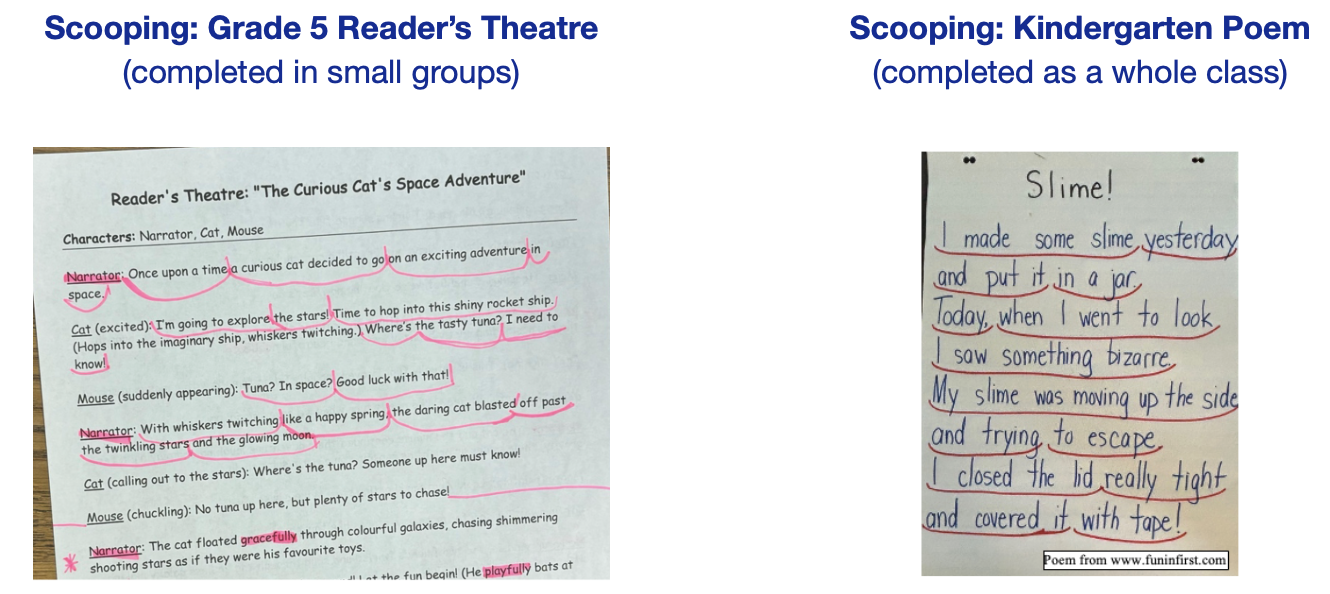
Scooping is a simple yet powerful way to support fluency, particularly in reading with prosody (expression, intonation, and phrasing). When you scoop a text, you draw a curved line (or “scoop”) under each phrase, showing where to pause. This helps readers see and hear natural phrasing, chunk text into smaller, meaningful parts, and sound more fluent. As a bonus, this often improves comprehension at the same time.
Choose a text for fluency practice.
Tip: Research suggests selecting a complex text to maximize learning. Poems and Readers’ Theatres are excellent choices!
Introduce and model fluent reading by reading the text to your students.
Echo read the text together, letting students match your pacing and expression.
Scoop the text into phrases, marking natural breaks. You might do this as a class to start, and then have students try it out in small groups.
Tip:There is no single right way to scoop a text. Expression varies depending on purpose, background experience, and knowledge. Allow for flexibility here and invite students to explain their reasoning.Re-read with the scoops, focusing on phrasing and expression.
Tip: If students are working in small groups, have groups perform for their peers, emphasizing how they scooped their text.Repeat often — the more students practice, the more their fluency will grow.
Challenge: Try this with a math problem and see what happens!
Coming up next
In our final newsletter of this series, we will focus on secondary students and share a practical strategy to help older readers continue refining their fluency. You won’t want to miss it!