Morphology (HOW 7-12)
The HOW of morphology

Secondary: HOW we teach morphology
By the time students reach junior high and high school, most of the texts they encounter are filled with complex, multimorphemic words, words made up of multiple meaningful parts. These longer, layered words can feel intimidating if students try to memorize them in isolation. Instead, we can help them draw on their morphological knowledge to unlock meaning and apply it flexibly across English, Science, Math, Social Studies, and other content areas.
Today, we are sharing a favourite morphology strategy that we have used in secondary classrooms. It is a practical approach that encourages students to annotate complex words directly in their texts. This helps to land morphology in context, leading to deeper understanding of content and opportunities to transfer learning. It also models how students can begin to independently approach intimidating words in academic reading in any subject.
Strategy: MORPHOLOGY in the MARGINS!
Select a challenging text passage from your discipline.
Identify 2-3 target words with rich morphemes (e.g., photosynthesis, revolution, misinterpretation).
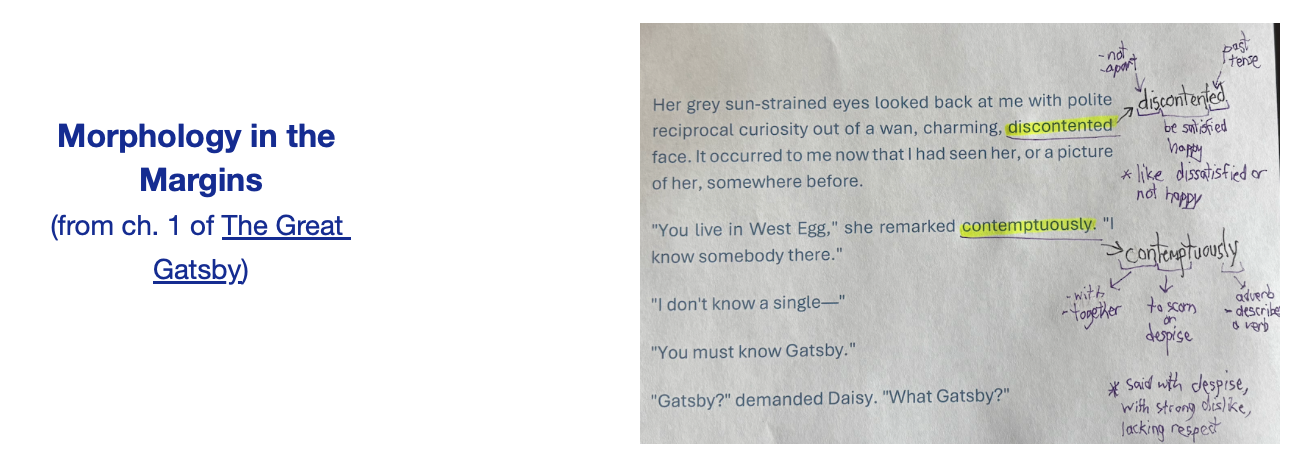
Tip: If you have a digital copy of the passage, use AI as a tool to help you identify key vocabulary words and their related morphemes. Check out Morpheme Mappers and Etymonline as additional helpful sites.Guide and support students in breaking down each word, writing out the morphemes and their meanings in the margins of the text.
Discuss how the morphemes shape both the meaning and grammatical role of the target words in the text.
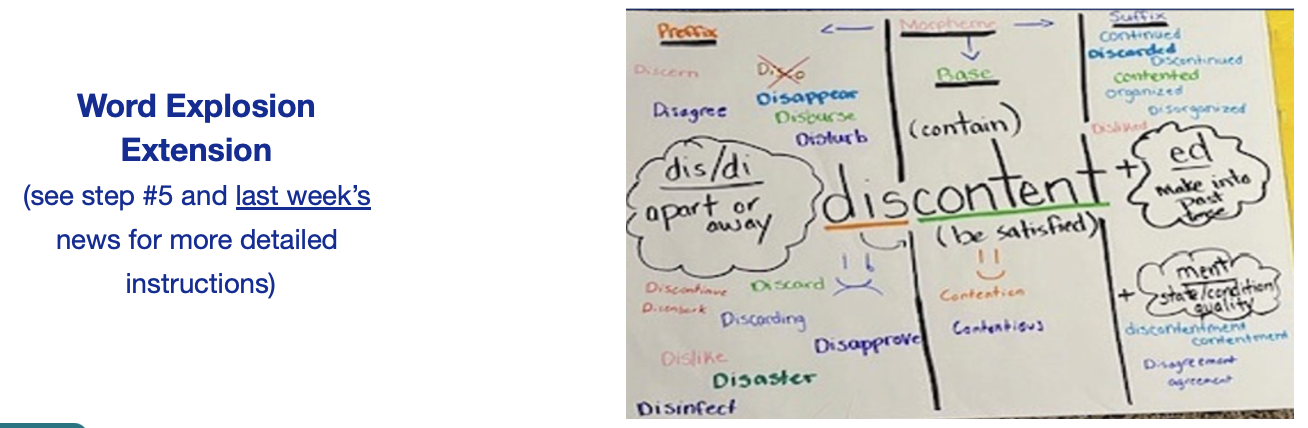
Extend student thinking and engagement by asking students to work in small groups to generate related words that share the same morphemes (prefixes, suffixes, and/or bases).
Tip: Having students do this in groups supports all learners and gives striving and multilingual learners the opportunity to expand their vocabularies at a faster rate.
Check out the grade 10 student samples below. The first illustrates using the margins for vocabulary and morphology development, and the second shows how you can extend this task in small groups (activity #5 above).
In closing…
Across this series, we’ve looked at what morphology is, why it matters, and how to teach it from early literacy through the secondary years. In elementary grades, morphology builds playful awareness of word parts. As students grow, they learn to connect morphemes across word families and disciplines and to use affixes (prefixes & suffixes) and bases to determine both meaning and grammatical function. Ultimately, morphology instruction is about empowering students with a toolkit they can carry for life; one that unlocks vocabulary, deepens comprehension, and supports success in every subject they encounter.