Morphology (HOW K-6)
The HOW of morphology

Elementary: HOW we teach morphology
We know it’s impossible to teach every word our students will encounter throughout school. That’s why teaching morphology is so powerful. It equips students with strategies they can carry across subjects and grade levels. Think of it as filling their “morphological toolbox” with tools they can use again and again. Today, we are sharing one of our favourite morphology strategies (that can be used in all grades)!
Strategy: WORD EXPLOSIONS!
Choose a mentor text, preview it, and select one morpheme from the text to teach.
Tip: Select a morpheme that aligns with your curriculum. Check out this great article for some ideas of what prefixes and suffixes to teach in elementary.
Before reading the text, introduce the morpheme to your class with a student-friendly definition (e.g., the prefix re means to do again).
Use the morpheme in some sentences to build understanding (e.g., I like to reread my favourite books; Let’s recreate our favourite movie scene).
Tip: Invite students to share some ways they can use the morpheme.Now, read the mentor text aloud, with students listening carefully for the target morpheme.
Tip: Pause when the morpheme occurs and discuss its use in the context of the text.After reading, try a Word Explosion. Students work in small groups to generate and write as many words that they can think of with the target morpheme. Make it a friendly competition, and have students tally the number of words they generated at the end of a timer.
Share & celebrate by having groups discuss spelling, meaning, and the connections they observe and hear between words.
Tip: Allow groups an extra minute at the end to add any new words to their word explosions.
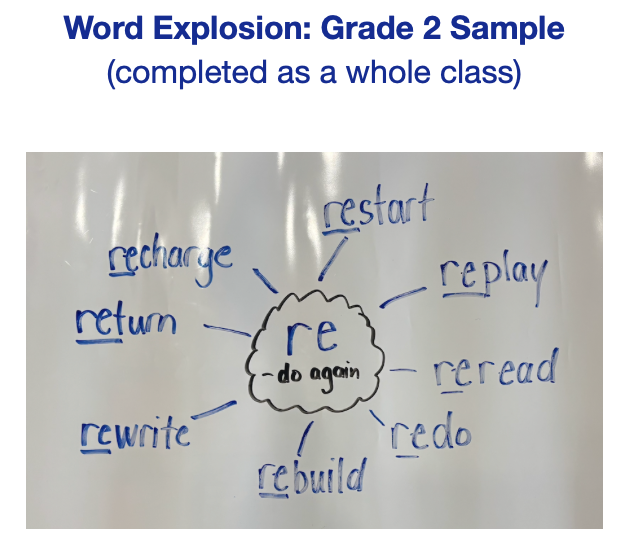
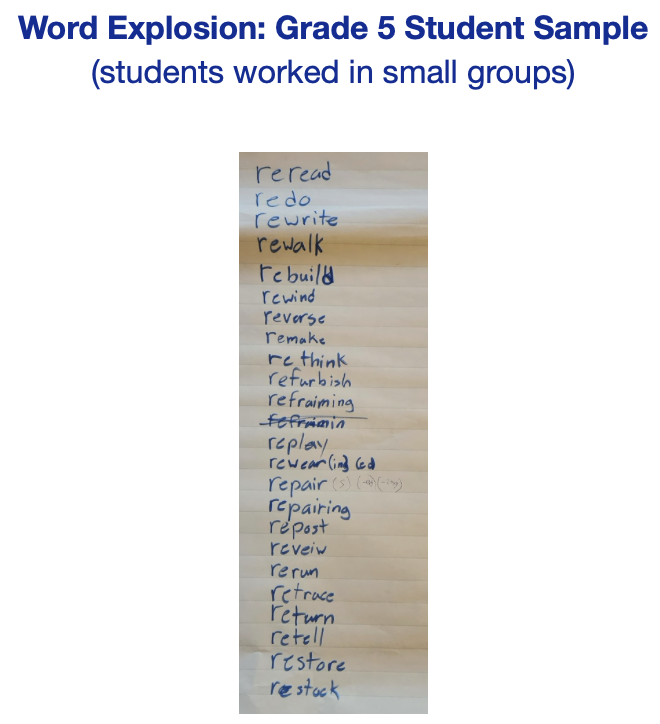
Below are two ways we have used Word Explostions in elementary classrooms using the prefix RE-. In grade 2, we did a whole-class word explosion, where students shared their words and we captured them on an anchor chart. In grade 5, students worked in groups of 3 or 4, writing down as many words as they could in 3 minutes before sharing out.
Coming up next
In our final newsletter, we will shift our focus to secondary students. While playful, hands-on approaches lay the foundation in the early years, older students need more advanced ways to apply their morphological knowledge. We will share a strategy that helps students decode dense academic vocabulary, connect across content areas, and confidently tackle the kinds of multimorphemic words that dominate secondary texts. These types of strategies are what turn morphology from a helpful tool into an essential skill for academic success. You won’t want to miss it!