Morphology (WHAT)
The WHAT of Morphology

Over the following few newsletters, we’ll be diving into a term that sounds a little like something from a biology textbook but has become one of the most talked-about topics in literacy instruction: morphology. Fifteen years ago, we would have struggled to tell you what it meant. Today, it’s nearly impossible to listen to a reading strategy session without hearing it. Morphology has quickly moved from an obscure linguistic concept to one of the star players in effective reading instruction, a true MVP in the literacy game.
What is a morpheme?
The word morphology comes from Latin roots, meaning the study of forms. In language, and specifically in linguistics, morphology is the study of how words are formed. In reading instruction, it means helping students examine words and break them into meaningful parts, called morphemes, to support decoding and comprehension.
A morpheme is the smallest unit of meaning in a word. Using morphology as a reading strategy means understanding that when certain letters “live together” in predictable patterns, they often carry a consistent meaning. Take the word transported: a reader might skip over it because it’s a longer word and visually complex. But with morphological knowledge, we can break it into its parts.
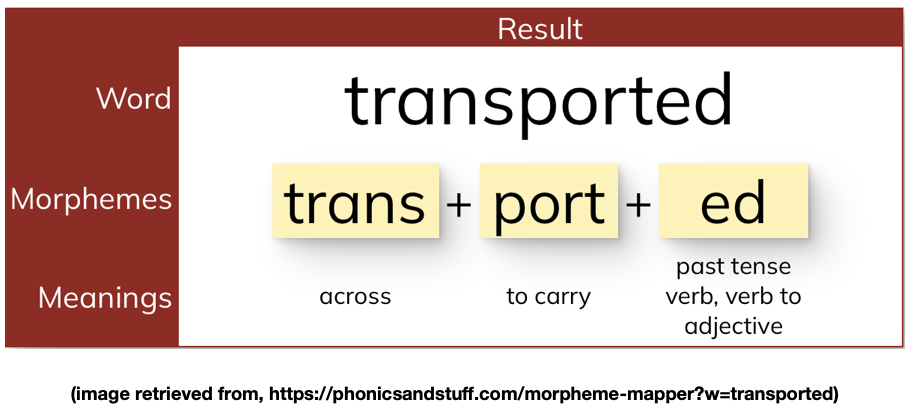
transported: to carry across (in the past)
When students recognize one or more morphemes in a word, they have already unlocked part of its meaning. For striving readers, this is powerful: knowing even a single piece of the puzzle makes it more likely they’ll stop, look, and attempt the word rather than skip past it.
Morphemes, morphemes everywhere
As English evolved, speakers began combining word parts, creating longer, multimorphemic words. Each added piece shifts the meaning or role of the original word. That’s the power of morphology: every morpheme adds meaning. When we teach students to spot the base (or root) morpheme, the heart of the word, they can then see how prefixes and suffixes reshape it. Simply noticing where new parts are added helps them unlock meaning and gain confidence as word-solvers.
Base or root morpheme – the core meaning of the word (port → port)
Prefix – added to the beginning to adjust meaning (trans + port → transport)
Suffix – added to the end to change the word’s grammar or function (transport + ed → transported)
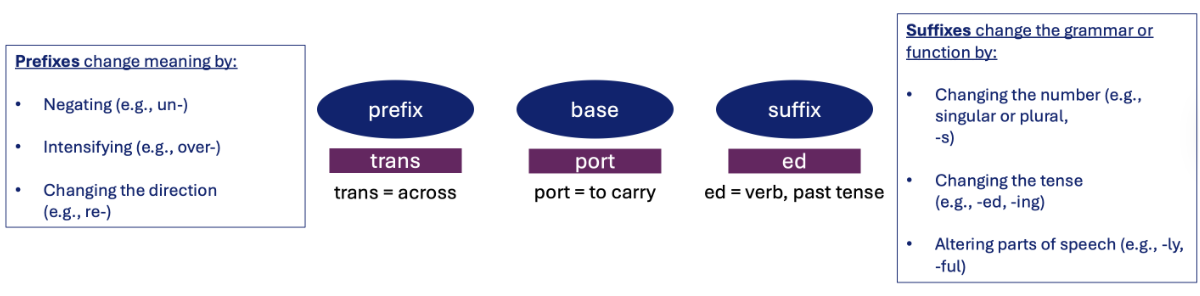
The way English builds words from morphemes is exactly why growing students’ morphological awareness matters so much. By high school, research suggests that as many as 90% of the words students encounter in texts are multimorphemic. That means, the more comfortable they are with word parts, the more confident they’ll be as readers and writers.
Check out one of our favourite morphology tools: Morpheme Mappers
Coming up next
In our next newsletter, we’ll explore why morphological awareness supports not just getting words off the page, but also building the kind of fluent, flexible comprehension that helps students tackle complex texts with confidence.