Sentence Structure & Syntax (HOW K-12)
The HOW of sentence structure and syntax

Elementary: HOW we teach sentence structure and syntax
Explicit sentence instruction does not mean going back to grammar drills. It is about guiding students to notice, play with, and apply sentence patterns as part of real writing.
In our last newsletter, we explored how hearing strong sentences builds an “auditory loop” that supports fluent writing. This week, we dive into one of the most effective (and fun) ways to strengthen that connection: sentence imitating. It builds syntactic awareness, rhythm, and control, all through meaningful language play.
Strategy: SENTENCE IMITATING!
Choose a mentor sentence from a read-aloud or text students have recently read or heard. Break the sentence into chunks that make sense for your learners. We often use the language of WHO, WHAT (or DO), WHEN, WHERE (we draw inspiration from The Writing Revolution & The Syntax Project).
Tip: Working from context, like a read-aloud, supports understanding and transfer.
Model how you would imitate the sentence. Think-aloud as you change one or more elements, while keeping the general structure of the sentence the same.
Students imitate the sentence in small groups. They can change just one part of the sentence, or reimagine the whole thing, while keeping the structure the same.
Tip: This can be done verbally, before moving to written versions.All groups share & celebrate
Tip: Having each group share their sentence strengthens that “auditory loop” and helps students internalize sentence variety, flow, and more complex language.
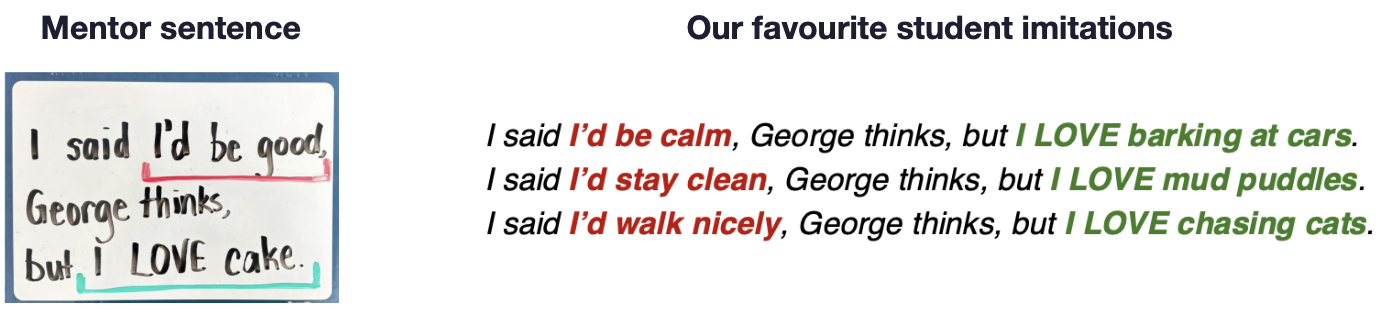
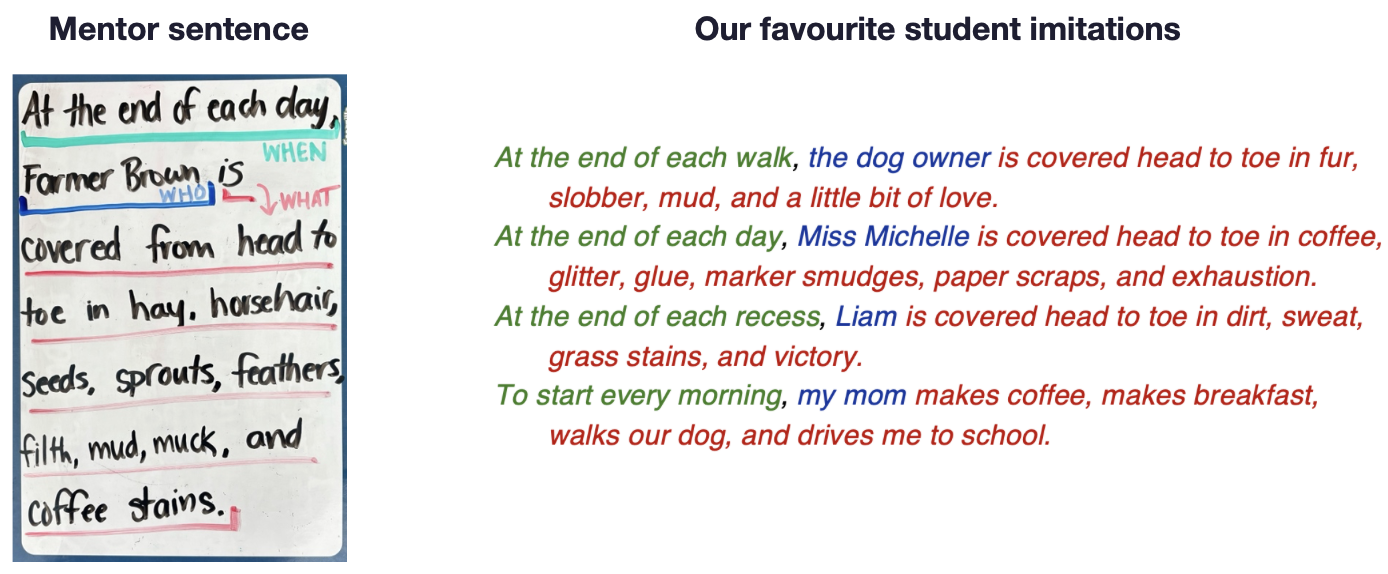
Below are 2 examples we have used in elementary classrooms, paired with our favourite student imitations! The first is from grade 1, where we limited the number of steps, and the second is grade 6, where students had free rein to get as creative as they liked. Enjoy!
Sample from grade 1, Oh No, George! (Chris Haughton)
Sample from grade 6, Duck For President (Doreen Cornin)
Try it out!
Pull a sentence from your current read-aloud or shared text.
Ask: “What can we change while keeping the general structure the same?” Then, listen as students play with new ideas and hear how rhythm, structure, and meaning start to click.

Secondary: HOW we teach sentence structure and syntax
Teaching sentence structure and syntax in secondary is more than making sure students write complete thoughts. It is about helping them connect ideas and communicate relationships clearly. Embedding sentence work in content topics allows students to move beyond short, choppy sentences and create more complex, nuanced statements.
Strategy: COMBINING CLAUSES with CONJUNCTIONS
Sentence combining is a powerful way to teach students how ideas relate to one another. Using coordinating and subordinating conjunctions, students can control meaning, tone, and emphasis, all while deepening their understanding of academic content.
Select any content-based topic and generate several simple sentences (leverage AI for this work)
Example (science)
the glacier melted
sea levels rose
coastal cities were flooded
Model how you could combine two of the sentences with a coordinating conjunction (FANBOYS). It is easiest to start with and, but and so.
Tip: Discuss how each conjunction changes the meaning of the sentence. Highlight punctuation, like the comma before coordinating conjunctions.
Example (science)The glacier melted, so sea levels rose. (so = shows the result of something)
Students practice sentence combining in small groups, working with the same list of simple sentences, or with a new set of related short sentences from the same unit. Students experiment with different coordinating conjunctions to see how they impact meaning and nuance.
Tip: Start with coordinating conjunctions before moving to subordinating conjunctions (e.g., because, although, while) to control for complexity.All groups share & compare
Tip: Having each group share a sentence or two strengthens that “auditory loop” (see WHY newsletter) and helps students internalize sentence variety, flow, and more complex language.
Check out the two student samples below, which illustrate how we have used this strategy in secondary classrooms.
Thanks for joining us on this first learning journey through sentence structure and syntax. Next, we will explore the WHAT, WHY, and HOW of morphology.
If you have any literacy topics that are sparking curiosity and wonder, let us know! Your input helps shape future publications.