Supporting Multilingual Learners (HOW K-6)
The HOW of supporting multilingual learners

Elementary: HOW we support multilingual learners
Throughout this series, we have emphasized the importance of honouring students’ home languages and leveraging the knowledge multilingual learners bring to the classroom. At the same time, students also need support in developing the English and academic language required to understand, discuss, and communicate content learning. One powerful strategy for doing both is verbal scaffolding.
Verbal scaffolding supports multilingual learners in connecting their existing knowledge and home language resources to new English vocabulary and concepts. It strengthens both comprehension (building understanding) and production (talking about and expressing understanding).
Strategy: LINGUISTIC REINFORCEMENT!
One common verbal scaffold is linguistic reinforcement: expressing the same idea in multiple ways using repetition, synonyms, examples, visuals, and think-alouds. In the example below, we showcase how we introduced the concept of‘Magnetic Field’and, through a series of steps,continually linked academic vocabulary to more familiar language through different linguistic scaffolds.
Introduce the academic term
Example: “A magnet has something called a magnetic field. You cannot see it, but it is the invisible space around the magnet where the magnet’s force works.”Use a concrete description
Example: “Think of it like an invisible bubble of magnetic power around the magnet.”
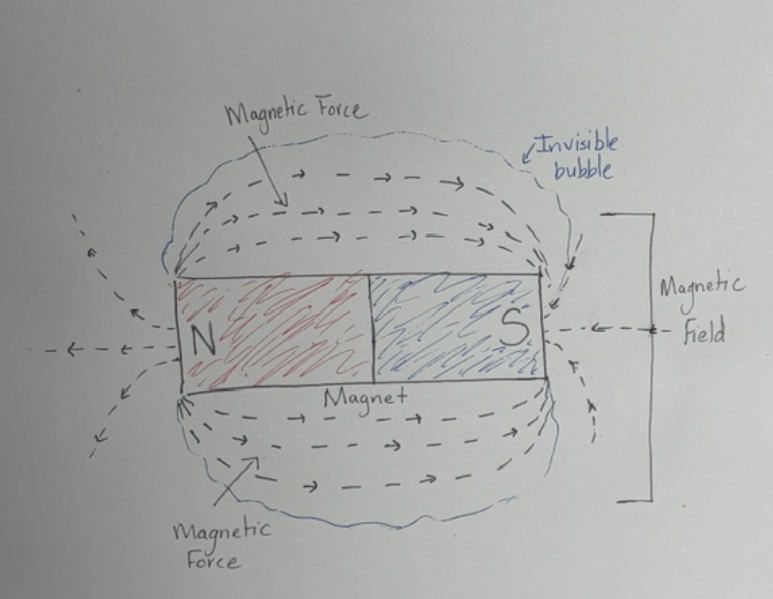
Focus on visuals and think-alouds
Example: (Teacher draws a magnet and field lines - see image) “These curved lines are not real lines in the air. They are a model to help us understand the magnetic field. The lines show the area around the magnet where the magnetic force is working.”
Require students to use target words in discussion
Example: “Turn to your partner. Talk about what a magnetic field is. Use one of these ideas: invisible space, invisible bubble, or where the force works. Try to use the terms ‘magnetic field’ and ‘magnetic force’ in your partner talk.”Prompt translanguaging
Example: “Now that we have talked about a magnetic field and drawn what it looks like, take a moment to think about this idea in the language(s) you know best. Do you know words for what you see happening in another language? Make your own picture and label it with English science words, and/or label it in your own words.”Teacher levels-up academic language (recasting) during discussions
Example: Student: “It’s like the magnet’s invisible power around it.”
Teacher: “Yes! I like how you said invisible power around it. In science, we would say a magnetic field is the invisible space around a magnet where the magnetic force works.”
Notice the use of linguistic reinforcement through the purposeful repetition of key words and ideas: magnetic field, invisible space, magnetic force, and invisible bubble. We connect academic language to multiple ways of understanding the concept, prompt students to draw on their own knowledge and languages to support comprehension, and provide opportunities for students to use the academic language to articulate and strengthen their understanding.
Coming up next
Many multilingual students have far more to say than they can easily capture in writing. In our next issue, we will explore how teachers can support secondary multilingual learners in transforming complex ideas into clear, confident, and effective writing through purposeful scaffolds, language supports, and instructional practices across the disciplines.